European Roulette at UK Online Casinos: Rules
 Available in GB
A practical guide to the single-zero wheel, bet payouts, online formats and the limits of betting systems.
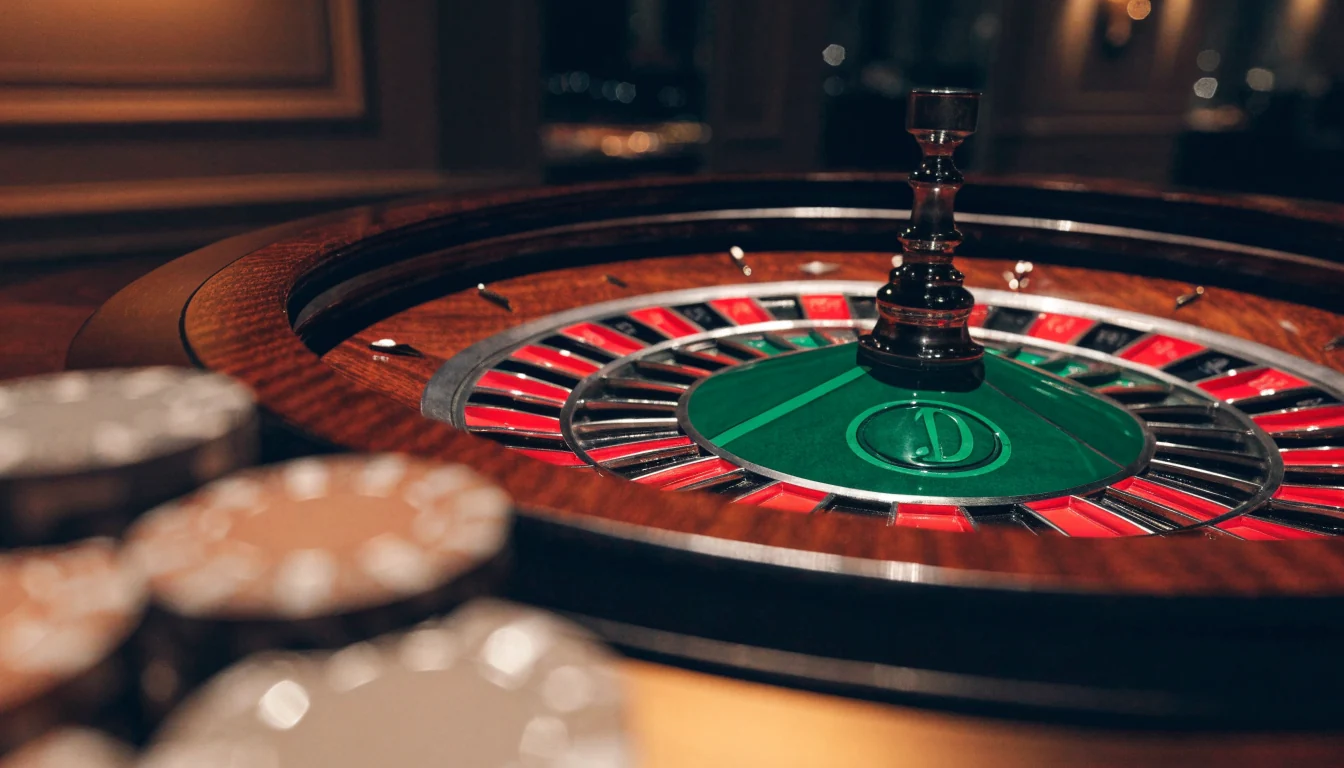
Table of Contents
- European Roulette: 37 Pockets and a 2.70% House Edge
- What “Best” Means in a Roulette Casino
- Playing Roulette: Bets, Payouts and the Limits of Systems
- Finding a Roulette Wheel Online: RNG, Speed and Minimum Stakes
- The Single-Zero Wheel and the Rules That Change the Calculation
- Free Play, Real-Money Stakes and Bonus Wagering
- Reading the Roulette Table Layout
- Roulette-Themed Slots Are Not Roulette Wheels
- Live Dealer Roulette: Physical Spins and UK Safeguards
- European vs American Roulette: The Cost of the Extra Zero
European Roulette: 37 Pockets and a 2.70% House Edge
European roulette uses a wheel with 37 pockets: the numbers from 1 to 36 and one pocket marked zero. That single zero is the defining feature of the standard European wheel. The stated house edge is 2.70%, a figure that describes the mathematical advantage built into the game over time.
The wheel’s pocket count is the starting point for understanding that edge. The zero is not an extra label outside the numbered sequence; it is one of the possible outcomes. A calculation that considers only the numbered pockets leaves out a real result and therefore does not describe the complete wheel. European roulette’s house edge reflects the wheel as it is actually constituted, including its single zero.
A house edge is a long-run measure, not a charge applied as a separate fee. It expresses the casino’s theoretical advantage in relation to the stakes placed under the game’s rules. The 2.70% figure does not mean that a fixed share is removed from every individual stake or that a particular session will produce a predictable loss. Individual results depend on chance. Over a short period, outcomes can differ substantially from the long-run expectation; the edge is a property of the game, not a forecast for one player or one visit.
That distinction matters when comparing the headline figure with a session’s actual result. A player may finish ahead, lose more than the theoretical average, or leave close to the starting balance. None of those outcomes changes the wheel’s structure or its stated edge. The calculation describes the underlying terms across repeated play, rather than assigning a guaranteed result to any one sequence of spins.
The single-zero wheel is therefore a useful baseline when assessing European roulette online. The game may be presented through different interfaces, but the key mechanical question remains whether the wheel has 37 pockets, including one zero. A title or visual design alone does not establish that structure; the game information and rules are the relevant places to confirm it. Where the format is European roulette, the 2.70% house edge provides the reference point for understanding its mathematical terms.
The percentage should be read as a theoretical rate, not as a promise of a particular return. It does not state how long a session will last, how many spins it will contain, or what balance will remain at the end. Those outcomes are not encoded in the edge. Roulette results are determined by chance, so no result on the wheel can be inferred from the previous result. A run of outcomes does not turn the next spin into a correction of the last one.
The same distinction prevents a common accounting error: treating a theoretical edge as if it were a personal spending limit. It is not a cap on losses, and it does not define the maximum amount that can be lost during a session. It is a comparative measure of the game’s long-run terms. The amount exposed in practice depends on the stakes and duration of play, while the edge describes the casino advantage associated with the game. Those are separate quantities.
For anyone comparing European roulette casinos, the wheel’s configuration and edge establish the game-level baseline; they do not settle every question about the conditions around play. A casino’s wider terms and the way its roulette offer is presented require separate assessment. Keeping those questions apart avoids attributing a game’s mathematical edge to an operator-specific condition, or mistaking an interface difference for a change in the wheel itself.
European roulette’s defining calculation is consequently simple to state but easy to misread: 37 possible pockets, with numbers 1 to 36 and a single zero, and a 2.70% house edge. The number is useful for comparing the game’s underlying terms, but it cannot turn chance into a predictable result.
What “Best” Means in a Roulette Casino
Choosing a European roulette casino in the UK involves checking practical details as well as the game itself. This reference card highlights the payout information available for each listed operator.
Payout speed: 1-3 business days EvoSpin lists a payout speed of 1–3 business days, a useful detail to consider when choosing a casino for European roulette.
Payout speed: 1-3 business days Dieselwin lists a payout speed of 1–3 business days. This gives players a stated timeframe to keep in mind when considering the operator.
Payout speed: 1-3 business days SlotoSport lists payouts as taking 1–3 business days, providing a clear practical detail for players considering its European roulette offering.
Payout speed: 1-3 business days x3bet has a stated payout speed of 1–3 business days. This is the available practical detail for players assessing the operator.
Payout speed: 1-3 business days Britsino lists a payout speed of 1–3 business days, giving players a timeframe to factor into their choice.
Payout speed: 1-3 business days WinBeast lists payouts as taking 1–3 business days. Players can use this stated timeframe when considering the operator.
Payout speed: 1-3 business days NightLuck has a stated payout speed of 1–3 business days, a practical point to note when evaluating it for European roulette.
Payout speed: 1-3 business days BeOnBet lists a payout speed of 1–3 business days. This provides one concrete detail for players to consider.
Payout speed: 1-3 business days Revery Play lists payouts as taking 1–3 business days, offering players a stated timeframe to bear in mind.
Payout speed: 1-3 business days Chanze lists a payout speed of 1–3 business days. This is a relevant practical detail when considering the operator.
“Best” is not a property of a roulette label. It is a judgement about the conditions attached to the game: whether its return information is accessible, whether the terms are clear, what account controls are available and where a dispute can be taken. A casino may offer European roulette without making those conditions equally easy to assess. The comparison is therefore about the offer around the table, not a promise that one operator will produce better results.
For a best European roulette casino in the UK, the first check is regulatory status. The UK Gambling Commission (UKGC) is the sole regulator of online casino activity in Great Britain. A site offering real-money gambling to British customers must hold the relevant UKGC operating licence; an offshore licence on its own does not meet that requirement. The licence number should be checked against the Commission’s public register before depositing. A familiar name or a polished page is not a substitute for a current entry.
UK Casino Verification
- Check for a valid UKGC operating licence
- Verify the licence number against the public register
- Confirm the availability of RTP and game rules
- Review full terms and conditions for wagering requirements
- Identify accessible account-level financial limits
- Locate the internal complaints process and ADR service
Return information should be available before play, not buried behind account access or an unclear game description. Look for the roulette game’s stated RTP information and the rules that explain how the figure applies. RTP is a theoretical measure of returns over extensive play, not a forecast of an individual session or a promise of a particular result. If the published information does not identify the game or explain its conditions, the number has limited value for comparison. Clear access matters more than a headline figure presented without context.
The same scrutiny applies to terms. Promotional wording is not the operative agreement: the full rules determine eligibility, expiry, withdrawal conditions and which games count towards any wagering requirement. Roulette may receive different game weighting from other casino games, and the relevant terms should say so. That is a cost question, not a strategy question. If the conditions cannot be found or are written ambiguously, the value of the offer cannot be calculated reliably.
Account limits are another measure of the practical offer. UKGC-licensed live casino operators must provide deposit limits, loss limits, session time reminders, reality checks, cool-off periods and GamStop self-exclusion. Remote operators must also prompt new customers to set a financial limit before their first deposit and make account-level limit controls accessible. These are operating conditions, not optional extras to be inferred from a general responsible-gambling statement. The available controls should be identifiable in the account or help pages.

Payment rules also belong in the terms check. UKGC-licensed casinos cannot accept credit cards for gambling, including credit-card funding routed through a money service business. A casino must also refuse wallet payments where the wallet permits credit-card funds to be used for gambling. If a payment method’s funding route is unclear, the advertised payment logo alone does not settle the question.
A fair comparison includes what happens when something goes wrong. UKGC licensees must provide an internal complaints process and access to an approved Alternative Dispute Resolution service. The site should explain how to submit a complaint and identify the route available if the operator’s response does not resolve it. A contact form without a stated process leaves the customer with less usable information than a published procedure.
Age verification is part of entry to real-money play: operators must verify a customer’s age before allowing funds to be deposited into a gambling account. That requirement is distinct from the appearance of the game lobby. A site can display roulette titles publicly while still requiring checks before deposit; the relevant question is whether the operator follows the required process.
- Verify the UKGC licence on the public register
- Check for clear RTP and game rule information
- Use accessible account-level limit controls
- Confirm the availability of an approved ADR service
- Rely on a polished page as a substitute for a licence
- Accept promotional wording as the operative agreement
- Assume optional extras from general gambling statements
- Use payment methods with unclear funding routes
Taken together, these checks define a more defensible meaning of “best European roulette casinos UK”: transparent game information, readable terms, accessible limits and a workable complaint route, under a valid UKGC licence. They do not identify a universal winner. They make the conditions comparable, which is a more useful result than a ranking that leaves the underlying terms out of the calculation.
Playing Roulette: Bets, Payouts and the Limits of Systems
A roulette bet sets two things: which result must occur for it to win, and how much is at risk if it does not. The broader the set of results covered, the more often the bet may win in principle, but the payout is lower. A narrow selection offers a larger stated payout but loses whenever the ball finishes elsewhere. Neither choice changes the wheel’s underlying chance.
Red/black, even/odd and high/low are outside bets. Each pays 1:1: a winning stake earns an equal amount in profit, with the original stake also returned. A stake of £1, for instance, would produce £1 in winnings plus the £1 stake. The net gain is £1, not £2; confusing the returned stake with profit overstates the result. These bets cover broad groups of outcomes, but a win is not guaranteed, and repeated losses remain possible.
Inside bets focus on smaller selections and carry larger payouts when successful. A straight-up bet on one number pays 35:1 in European roulette. That is a quoted profit of 35 units for each unit staked, plus the original stake returned if the bet wins. The headline payout is not an expected return: it applies only when the selected number is the result. A high payout compensates for the narrow condition, rather than making the bet favourable.

The same distinction applies across bet types. A payout table states what a winning selection earns; it does not state how likely a particular spin is to produce that result. For a practical comparison, the relevant figures are the stake, the net profit if successful and the amount lost if unsuccessful. Those terms make unlike bets comparable without treating a larger payout as evidence of better value.
Staking systems change the size and sequence of bets, not the results. The Martingale system, for example, doubles the stake after each loss, on the assumption that a later win can recover earlier losses and leave a gain. That calculation depends on a win arriving before the growing stakes exceed the available bankroll or the table’s permitted range. A losing streak can therefore increase exposure quickly. Each additional loss leaves more money committed to the next attempted recovery; the system does not remove that liability.
No roulette strategy can predict the final outcome. The odds are determined by chance, so previous results do not make a particular colour, number or range due on the next spin. A staking plan can organise spending, but it cannot improve the probability attached to a selection or turn a losing bet into a winning one.
For anyone choosing to play European roulette online in the UK, the calculation should remain separate from the presentation of the game. A larger stake increases the amount at risk; a system that escalates stakes can make that increase abrupt. The payout is conditional on the result, and the result remains uncertain.
Attention: No roulette strategy can predict the final outcome or improve the probability of a selection, as results are determined by chance.
Finding a Roulette Wheel Online: RNG, Speed and Minimum Stakes
An online roulette game can use a simulated result or present a wheel through a live stream. The difference affects how quickly spins follow one another and what minimum stake may be available; it does not, by itself, identify the wheel’s rules or the layout of its betting table.
RNG roulette uses a random number generator to produce each simulated spin. There is no physical ball drop to wait for, so the game can move at a faster pace than a streamed table. Minimum stakes are also lower in some versions, with RNG roulette often available from 10p. That makes it possible to keep the amount committed to each spin small, although a lower minimum does not change the result’s randomness.
A standard table moves at a more measured pace. One specialist review puts a standard table at 80–100 spins per hour and reports that speed roulette can exceed 150 spins per hour. Those figures describe the formats in that review, not a fixed rate for every operator or game. The practical distinction is that speed roulette reduces the interval between rounds; it does not make any individual result more predictable.
That difference in pace has a direct cost implication. If a stake is repeated automatically or simply placed again after each result, more rounds can mean more money exposed during the same playing period. A faster format therefore changes the rate at which a bankroll is put at risk, not the odds attached to a particular spin. The number of spins completed is not a measure of value.

The term “European roulette” describes the game’s wheel format, not whether it is delivered by RNG or as a live stream. A European roulette wheel with a green zero can appear in either presentation. In a simulated version, the wheel and ball are represented on screen while the RNG determines the result. In a live version, the game shows a physical wheel and ball drop. The display may look similar, but the underlying delivery is different.
When comparing an online casino with European roulette, the game information should make its format clear before play begins. The stated minimum stake is a separate condition: it determines the smallest permitted wager, not the speed of the game or the chance of a particular result. An advertised low entry stake can be relevant to the amount placed per round, but it should not be mistaken for a cap on total spending.
For a European roulette casino wheel, the useful distinction is therefore between pace and presentation. RNG games prioritise quick simulated rounds and can have a minimum stake as low as 10p. Speed roulette is identified by its shortened interval between rounds, while a standard table proceeds more slowly. Neither label guarantees a particular minimum or speed across every game. The displayed rules and stake controls, rather than the animation alone, determine the conditions attached to the session.
The Single-Zero Wheel and the Rules That Change the Calculation
A single-zero wheel and the rule applied when the ball lands on zero are separate parts of the calculation. The European wheel has one green zero; a table may use standard settlement or offer La Partage for eligible bets. The pocket structure does not change when that rule is added. What changes is the amount returned after a particular result.
On a single-zero wheel, the house edge for even-money bets falls from 2.70% under standard settlement to 1.35% when the La Partage rule is applied.
La Partage applies to even-money bets, such as red or black. If the ball lands on zero, half of the stake on an eligible bet is returned rather than the entire stake being lost. The other half is lost. The rule does not turn zero into a winning result for either side, and it does not apply to every type of wager on the table.
That partial refund changes the long-run cost of an even-money bet. On a single-zero wheel, the house edge for those bets falls from 2.70% under standard settlement to 1.35% with La Partage. The reduction is material, but it is not a promise of a better result on any individual spin. On outcomes other than zero, the rule does not provide the same refund; when zero appears, it limits the loss rather than erasing it.
This distinction matters when comparing European roulette betting options. A table’s name or appearance does not, by itself, establish how zero is settled. The relevant detail is in the game rules: whether La Partage is offered and which bets qualify. If the rules do not state that the half-stake refund applies to even-money bets, it should not be assumed. The displayed house edge is meaningful only when it corresponds to the settlement terms actually in force.
La Partage does not improve the chance of a chosen colour or parity appearing. It changes the financial consequence of zero for a specific class of bets. A player can therefore face the same wheel outcome while experiencing a different loss on that outcome, depending on the table’s rule. In accounting terms, the event is unchanged; the debit is smaller.
French roulette has the lowest house edge among standard variants because it can combine La Partage with En Prison. These are distinct rules, not alternate names for the same settlement. La Partage returns part of an eligible stake when zero lands; En Prison retains an eligible stake for another decision under its own terms. A table that offers one should not automatically be treated as offering the other.
The practical comparison is therefore between the wheel and its rules together. A European single-zero table identifies the wheel format, while its settlement rules determine how some losses are recorded. For even-money bets, La Partage reduces the stated house edge to 1.35%. That is a lower cost than standard settlement on those bets, not a reversal of the house advantage or a prediction of the next result.
Free Play, Real-Money Stakes and Bonus Wagering
A free European roulette game is a practice version: spins use no deposited balance, and any displayed winnings cannot be withdrawn as cash. A European roulette demo can help show how the interface works, but it does not reproduce the financial cost of real-money play. A roulette game is also not a “slot demo”; slots are a different game category, even when their names borrow roulette terms.
Real-money European roulette uses funds from a gambling account. UKGC-licensed operators must verify a customer’s age before allowing a deposit, and online gambling is legal in Britain for people aged 18 or over when the operator holds the relevant UK Gambling Commission licence. Deposits cannot be made by credit card. The restriction also covers credit-card funds routed through a money service business, and operators cannot accept wallet payments if the wallet allows credit-card funds to be used for gambling.
Payment Restrictions
UKGC-licensed operators cannot accept credit cards for gambling, including funds routed through a money service business or wallets permitting credit-card use.
Bonus funds have a separate calculation. The offer’s wagering requirement states how much qualifying stake must be placed before the bonus, or winnings linked to it, can be withdrawn. Roulette’s game weighting determines how much each stake reduces that requirement. Most UK operators count roulette wagers at 10% to 20% of the requirement, but the precise rate depends on the operator and game.
That percentage changes the effective cost of clearing an offer. If roulette carries 10% game weighting, only a tenth of each qualifying stake is credited towards the requirement; at 20%, a fifth is credited. The balance remains to be met through further qualifying play. Some specialist reviews report a wider distinction: live roulette may receive 10% or 20% weighting, while RNG roulette may count at 100%. These are reported terms, not a universal rule; the operator’s bonus conditions determine the actual calculation.
A regulatory summary of the 2026 rules states that, from January 2026, bonus wagering for UKGC-licensed operators is capped at 10 times the bonus amount. That cap does not make every offer equally usable. Game weighting, exclusions, expiry conditions and withdrawal rules still affect whether the bonus has practical value. Roulette excluded from wagering contributes nothing, regardless of the stake.
The useful comparison is therefore between the amount of bonus funds offered and the qualifying stake required after game weighting is applied. A higher weighting reduces the amount of roulette play needed to satisfy a requirement; a lower weighting leaves more of the requirement outstanding. Practice play has no such calculation because it is not a deposit-funded bonus and does not create withdrawable winnings.
Reading the Roulette Table Layout
A European roulette table combines a numbered grid with betting areas around it. The grid contains the numbers from 1 to 36, arranged in three columns, while the single zero sits apart from those numbered cells. The layout is a map of where a chip must be placed: a position inside the grid selects numbers, while a marked area outside it selects a broader group.
The smallest selections use the numbered cells themselves. A chip placed directly on one cell is a straight-up bet on that number. To cover two adjacent numbers, the chip sits on the line dividing their cells. This is a split bet, which pays 17:1 if either selected number wins. The dividing line matters: a chip centred on a cell is not the same selection as one placed between cells.
A street covers a horizontal row of three numbers. Its chip is positioned at the outer edge of that row, rather than on an individual cell or the line between two cells. A winning street bet pays 11:1. The arrangement makes the distinction visible: a split touches two neighbouring cells; a street marks a complete row.
Other inside bets use boundaries where several cells meet or cover a larger rectangular group. Their exact coverage depends on the chip’s position, so a table’s markings and the game’s help panel are worth checking before a spin. A chip placed slightly off its intended point can correspond to a different bet, or may not be accepted.
Inside Bet Payouts
A straight-up bet on one number pays 35:1, meaning a profit of 35 units for each unit staked, plus the original stake returned. A split bet on two adjacent numbers pays 17:1, while a street bet covering a horizontal row of three numbers pays 11:1.
Outside betting areas sit beyond the numbered grid. These are labelled for selections that group numbers by colour, parity or range. Their boxes are separate from the individual numbered cells, so they do not select a particular number. The zero remains distinct from those groups; it is not part of red or black, odd or even, or the low and high ranges.
On screen, the European roulette casino table layout may be compressed to fit a phone, but the underlying positions remain the same. Enlarging the board or opening the table rules can clarify which cells a chip covers and how a payout is stated. Payout notation such as 17:1 describes the return relative to the stake; the stake’s treatment should be read in the game rules.
A European roulette strategy cannot be read from the grid. The layout identifies the selection and its payout, not a way to change the result of a spin. Understanding the placement prevents a basic betting error; it does not improve the odds of the chosen numbers.
Roulette-Themed Slots Are Not Roulette Wheels
A roulette name or visual theme does not make a game a roulette wheel. A slot can borrow the table, ball or lightning imagery while remaining an online slot, with its own game rules and outcomes. The distinction matters because European roulette odds cannot be applied to a slot simply because its title or screen resembles a wheel.
Book of Dead is a slot, not a roulette game. XXXtreme Lightning Roulette is another named product, but its branding alone is not enough to establish which category or rules apply in a particular version. The game’s information panel and paytable identify what is being played. A label such as “3D European roulette”, “European roulette gold” or “European roulette platinum” is not, by itself, evidence that the game uses a roulette wheel or its betting rules.
For a real roulette game, the outcome concerns a ball landing in a numbered pocket. A slot instead operates under the rules set out for that slot. Its displayed symbols, features and paytable determine how outcomes are settled; roulette’s standard odds do not carry across. The useful test is therefore the game type and its rules, not the artwork. A product name can describe a theme. It cannot do the accounting.

That classification also determines which British restrictions apply. Online slot autoplay is banned, and each slot spin must take at least 2.5 seconds. The maximum stake per game cycle is £5 for customers aged 25 and over, and £2 for those aged 18 to 24. The £5 limit for adults aged 25 and over took effect on 9 April 2025. These are slot rules, not roulette-table limits.
Real-money online gambling in Great Britain is legal only through a UK Gambling Commission (UKGC)-licensed operator. Operators must verify a customer’s age before allowing deposits; the legal minimum age for online gambling is 18. A slot-style interface does not remove those requirements, and a roulette-style title does not turn a slot into a table game.
The practical check is the product’s classification, its rules and its paytable before staking. If it is listed as a slot, the relevant slot restrictions apply even when the screen borrows roulette’s appearance. If it is listed as roulette, its wheel rules govern instead. Similar graphics are not similar odds.
Roulette vs Slots
- Roulette-themed slots operate under slot rules, not roulette odds
- Online slot autoplay is banned in the UK
- Slot spins must take at least 2.5 seconds
- Maximum stakes for slots are capped at £5 (age 25+) or £2 (age 18-24)
- Product classification determines which regulatory restrictions apply
Live Dealer Roulette: Physical Spins and UK Safeguards
Live dealer roulette uses a physical wheel in a studio. A camera streams the table, while a human dealer releases the ball and announces the result. The distinction from a simulated wheel is practical: the spin is visible as it happens, but the stream does not change the terms or safeguards attached to real-money play.
A specialist review reports that UK live roulette table minimums can start at 10p; it also places some auto-roulette and speed formats at 5p. These are reported entry points, not a promise that every table has the same minimum. The displayed table limit determines the amount accepted for a particular game.
Real-money live roulette in Great Britain must be offered by a UK Gambling Commission (UKGC)-licensed operator. A platform without a valid UKGC licence cannot legally offer it to British residents. The operator must verify a customer’s age before allowing a deposit, and the legal age to gamble online is 18. Licence details can be checked against the UKGC public register before funds are deposited.
The account controls are part of the operating conditions, not optional table features. Remote operators must prompt new customers to set a financial limit before their first deposit and provide accessible account-level controls. UKGC-licensed live casino operators must also offer deposit and loss limits, session-time reminders, reality checks, cool-off periods and GamStop self-exclusion.
Payment rules apply at the account level. UKGC licensees cannot accept credit cards for gambling, including credit-card funding routed through a money service business. A wallet cannot be used for gambling where it permits credit-card funds to be spent. These restrictions apply even when the live table itself accepts a deposit through another route.
If a dispute arises, a UKGC licensee must provide an internal complaints process and access to an approved Alternative Dispute Resolution service. Operators are also required to contribute to the Research, Education and Treatment levy. These obligations sit around the streamed game; a visible dealer does not replace the operator’s regulatory duties.
European vs American Roulette: The Cost of the Extra Zero
The difference between European and American roulette is not cosmetic. The European wheel has 37 pockets: numbers 1 to 36 and one zero. The American version adds a second green pocket, marked 00, bringing its total to 38. That extra pocket changes the probability attached to every standard wager, while the payout remains the same.
On a standard European wheel, the house edge is 2.70%. On the American wheel, it is 5.26%. The gap is 2.56 percentage points. Put another way, the American edge is almost twice the European figure. The difference follows from the additional losing outcome: a wager on a number, colour or other standard category faces another pocket that can defeat it without improving the payout.
This comparison is useful when choosing an online European roulette casino game: the wheel’s label alone is not enough if the table rules are unclear. The pocket count should be visible in the game information or on the table itself. A double-zero layout is American roulette, even when it appears alongside European tables in the same lobby.
The American basket bet carries a still higher house edge of 7.89%. It covers a small group of low-number pockets, including the zeroes, but the payout does not compensate for the odds attached to that group. The bet can therefore be materially less favourable than the standard American layout already is.
A further variation adds a third green pocket, 000. A specialist review reports that this layout has a 7.69% house edge. That figure belongs to the specific three-zero version described, not to American roulette as a whole; the presence of 000 changes the calculation and should be checked on the individual table.
For a straightforward European roulette vs American roulette comparison, the pocket count is the first test and the house edge is the practical result. A single zero produces the lower stated edge; a double zero raises it, and a 000 layout is a separate variation. The distinction is measurable before a spin begins.
What does online casino roulette for real money mean?
It means wagering money on roulette through an online casino, rather than playing for free. The amount at risk depends on your stakes and how long you play.
How does roulette actually work?
A ball lands in one of the wheel’s pockets, and the result is determined by chance. A European wheel has 37 pockets: numbers 1 to 36 and one zero.
Should I play American or European roulette if I’m in the UK?
European roulette has a lower house edge: 2.70%, compared with 5.26% for standard American roulette. European wheels have one zero; American wheels have a zero and a double zero.
Created by the ”Jeanniemarshall.com” editorial team.